Read the Frequently Asked Questions
Most Fire Pumps range from 150 GPM - 5000 GPM. Purchase what will cover 90% of your potential tests in your area. We recommend:
(6) FLOWBUSTERS
(4) Nozzle Inserts,
(2) Stacking Connectors (3 high each)
(1) Pitot tube
(8) 25foot, 3in Fire Hoses (not the 2-1/2") with 2-1/2"NST connections
(2) 50ft, 3in Fire Hoses with 2-1/2"NST connections
This will provide you enough hose initially to run (3) lines for 100 ft, (4) lines for 75 ft ea, or (6) lines for 50 ft ea. Using 3 in hose will reduce friction losses, so you can use fewer hoses per test. Using 25 ft. lengths saves the wear and tear on your back.
You will also need a good digital tachometer, an Ampmeter/Voltmeter, and test gauges that have been calibrated and a good, active brain.
Yes, the FLOWBUSTER is not only light (8lbs), but compact. It is extremely strong and should provide you with years of use in the field.
We have tested the FLOWBUSTER to readings above 100psi but do not recommend it, nor is it really needed to go that high. Your accuracy is better at the lower values and the pressures less likely to get you in trouble.
Each fire pump is provided with a specific number of hose valves. A 2000GPM unit would be furnished with 6 valves. The number required actually depends on the pump discharge pressure and the friction losses from the pump to the FLOWBUSTER Nozzle. If the fire pump has a boost pressure of 40psi and is pulling from a ground storage tank, and you are using 100ft hoses you would probably need all 6. With a city pressure of 60psi and a pump boost pressure of 100psi using 25ft, 3in hoses, you would only need 3.
The "Stacking Connector" keeps a stack of FLOWBUSTERS in line and helps to prevent tipping over due to hose twisting. Without it, the stack may tip over as the hoses try to straighten out if twisted during layout. If they tip over, nothing bad happens, but things and individuals can get wet. The Stacking Connector has two stabilizers that extend out and lock in place during use. The stabilizers fold along the FLOWBUSTER sides during transport. Most folks keep the connector attached for convenience.
Yes, gentle to moderate slopes are no problem for the FLOWBUSTER due to its design. The guide vanes direct the water vertically, which results in applying a downward force that keeps it anchored. A "Three" stack can exert a downward force of 60-75 lbs depending on the flow.
Loose gravel. Loose gravel surfaces will be disturbed within 4ft. of the FLOWBUSTER. We suggest having a 4'x8' or 5'x10' tarp handy to place under the FLOWBUSTER stack during testing. It beats a shovel.
Accurate readings are important. The FLOWBUSTER is a platform to allow qualified test personnel to obtain the most accurate values possible. The water stream is completely exposed to allow the Pitot tube to be positioned at the most optimum place to achieve accurate flow. Unlike in a laboratory, this position is never in the same place, varying with every hose layout.
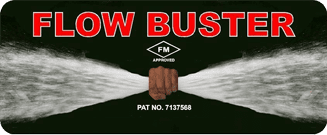
The FLOWBUSTER has been field tested for over three years. It was patented in 2006 (US Patent No 7,137,568). The system works!
The weight savings alone is worth the purchase. Climbing up ladders, stairs and putting them in and out of vehicles is almost effortless. Conserving storage space is always important. The FLOWBUSTER stacks in 1/3 the space required by other systems.
The flow stream is completely exposed to allow the operator to seek the most representative reading.
In and out of the water, the FLOWBUSTER will help to make your results more accurate with less effort.
YES, The FLOWBUSTER is FM Approved. At this time, the FLOWBUSTER is not Listed by UL.
Yes. Your hose connected to the FLOWBUSTER needs to be as straight as possible (at least 5 feet from the device) for accurate readings. Straighten the hose, and the flow stream should look more like the ones posted on our site.